
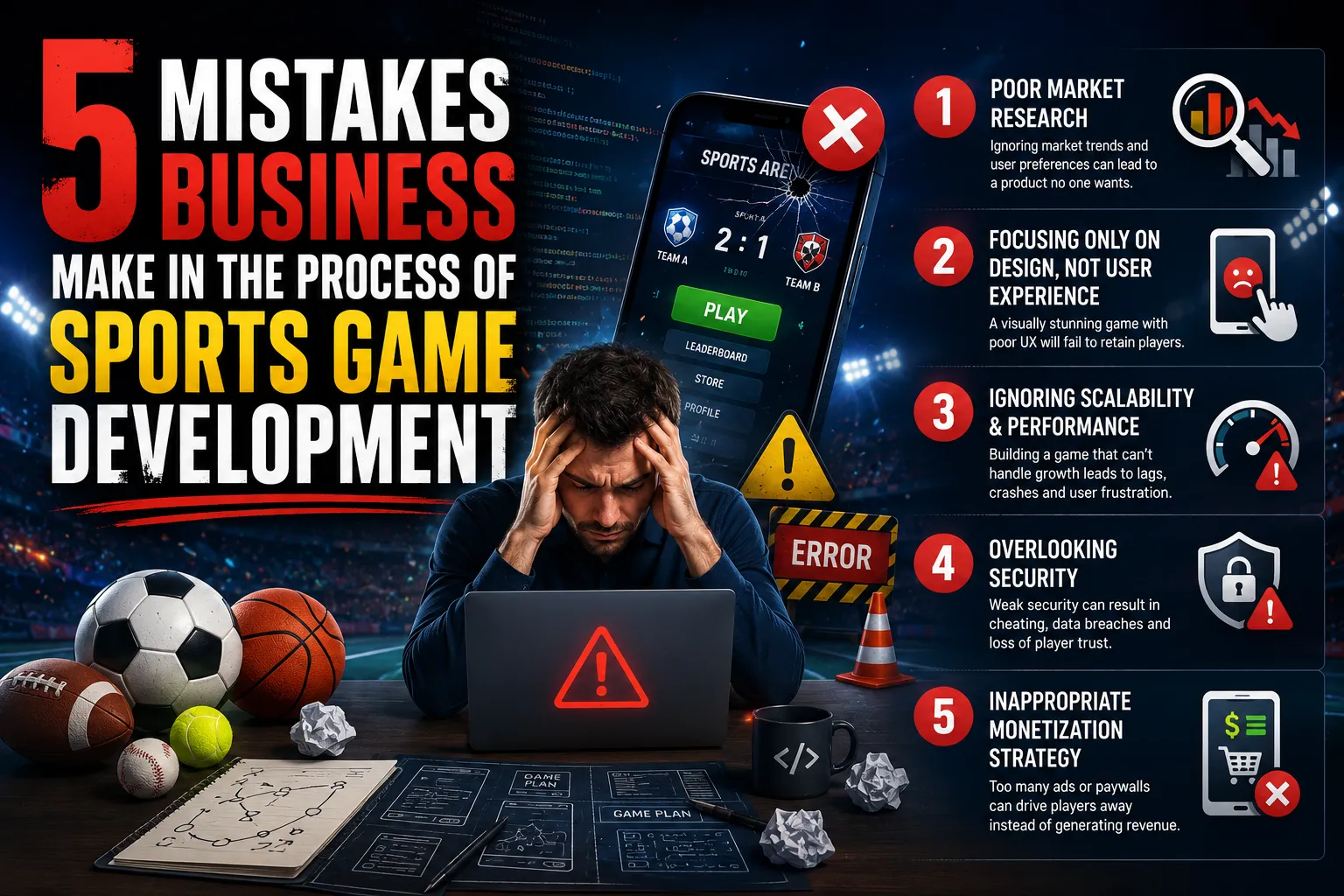
Table of Contents
- Mistake No 1 – Starting With Features Instead of a Business Model
- Mistake No 2 – Underestimating Real-Time Data & Infrastructure Complexity
- Mistake No 3 – Ignoring Compliance and Licensing is a BIG MISTAKE
- Mistake No 4 – Poor Communication & Blind Trust in the Development Agency
- Mistake No 5 – Launching Without a Product Roadmap
- Steps Owners Should Follow When Building a Sports Game
- How Owners Can Effectively Monitor Development Work
- Defining a Roadmap for the Best Sportsbook or Sports Exchange Platform
- Final Thought
- FAQ
The best sports game development platform looks deceptively simple from the outside. Brands see popular apps, sportsbooks, or prediction games and think, “Let’s build one, hire an agency, and launch.”
In reality, sports platforms sit at the intersection of real-time data, scalability, compliance, UX psychology, and monetization, and mistakes compound quickly.
Below are the five biggest mistakes while building your own sports betting development platform, followed by what owners should know, the steps they should follow, how to monitor agencies, and how to define a solid roadmap.
Mistake No 1- Starting With Features Instead of a Business Model
Many brands begin sports gaming development by listing features:
- Live scores
- Betting markets
- Leaderboards
- Wallets
- Multiplayer modes
But they haven’t answered the most important questions:
- How does this platform make money?
- Who pays, when, and why?
- What problem are we solving better than existing apps?
Why is this dangerous?
Without a clear business model, don’t move too fast
- Features balloon uncontrollably
- Development costs explode
- Monetization is added later, and this usually fails
What owners should know
The best sports gaming development platform or sportsbook is not a product, it’s a business system-
- Odds margins
- User lifetime value
- Acquisition costs
- Retention mechanics
What to do instead
Before any design or development-
- Define primary revenue stream (bets, rake, subscriptions, ads, or NFTs)
- Identify core user persona (casual fans vs sharp bettors)
- Decide win condition (volume, engagement, margins, virality)
Mistake No 2- Underestimating Real-Time Data & Infrastructure Complexity
Best Sports betting development platforms live or die on data accuracy and speed:
- Odds feeds
- Live scores
- Match states
- Player statistics
Many brands assume APIs just work.
Why is this dangerous?
- Delayed data = bad odds = financial loss
- Inconsistent feeds = disputes & refunds
- Poor scaling = crashes during peak events
A World Cup or Super Bowl will stress your system more than 6 months of normal usage combined.
What owners should know
Sports game development platform is infrastructure-heavy, not just UI-heavy-
- WebSockets or streaming data
- Failover mechanisms
- Redundant providers
- Load balancing
- Latency optimization
What to do instead
- Choose reputable sports data providers
- Design for peak traffic from day one
- Budget separately for infrastructure and APIs
- Ask the top sports game development agency in India about stress testing (not just QA)

Mistake No 3- Ignoring Compliance and Licensing is a BIG MISTAKE
This mistake kills projects silently. Sports betting, sports book, and exchanges are highly regulated, and rules vary by:
- Country
- State
- Payment provider
- Sport type
Why is this dangerous?
- Apps removed from app stores
- Payment gateways frozen
- Legal penalties or forced shutdowns
Many brands only think about compliance after development.
What owners should know
Please note that you are responsible, not your agency.
Key compliance areas include:
- KYC / AML
- Age verification
- Responsible gaming tools
- Data protection
- Licensing requirements
What to do instead
- Decide target markets before development
- Consult legal experts early
- Build compliance hooks into the architecture
- Avoid “we’ll add this later” thinking

Mistake No 4- Poor Communication & Blind Trust in the Development Agency
A common failure pattern- “We hired an agency and trusted them to handle everything.”
That almost always backfires.
Why is this dangerous?
- You lose visibility into progress
- Technical debt accumulates
- Decisions are made without a business context
- Timelines slip with no accountability
What owners should know
You don’t need to code, but you must manage.
Top Sports game development requires:
- Clear documentation
- Transparent milestones
- Regular demos
- Shared ownership of decisions
How owners should monitor the agency
Keep raising questions -
- Weekly or bi-weekly sprint reviews
- Access to task boards (Jira or Trello)
- Staging builds for testing
- Clear explanations in business language
Point the Red flags-
- Vague updates (“we’re working on backend stuff”)
- No demos
- Repeated delays with unclear reasons
- Resistance to documentation

Mistake No 5- Launching Without a Product Roadmap
Many platforms “launch” and then panic:
- Users don’t retain
- Monetization is weak
- Feedback overwhelms the team
Why is this dangerous?
Without a roadmap:
- Priorities shift randomly
- Features are built reactively
- Teams burn out
- Growth stalls
What owners should know
A sports platform is never finished.
It evolves based on:
- User behaviour
- Data insights
- Market response
Steps Owners Should Follow When Building a Sports Game
Step 1: Strategy & Validation
- Define niche (betting, exchange, prediction)
- Analyse competitors
- Validate demand with MVP thinking
Step 2: Product Definition
- Core features only
- Monetization logic
- User journeys
- Compliance scope
Step 3: Technical Architecture Planning
- Data providers
- Backend stack
- Scalability strategy
- Security model
Step 4: MVP Development
- Focus on one sport or market
- Launch with limited users
- Measure retention and engagement
Step 5: Iteration & Scaling
- Optimize UX
- Add features gradually
- Expand markets carefully

How Owners Can Effectively Monitor Development Work
You don’t need micromanagement, just structure.
Best practices-
- Clear KPIs per milestone
- Demo-based approvals
- Separate QA or testing phase
- Performance benchmarks (load, latency)
Questions that you should ask before hiring the best sports gaming development company -
- “How will this scale during peak events?”
- “What happens if the data feed fails?”
- “How easy is it to add a new sport?”
If they can’t explain simply, that’s a problem.
Defining a Roadmap for the Best Sportsbook or Sports Exchange Platform
A strong roadmap is phased, not feature-stuffed.
Phase 1- Core Platform
- User accounts
- Betting or game logic
- Wallet & transactions
- Live data integration
Phase 2- Trust & Retention
- KYC / security
- Responsible gaming tools
- Notifications
- Basic analytics
Phase 3: Growth & Engagement
- Promotions & bonuses
- Social features
- Advanced markets
- Referral systems
Phase 4: Optimization & Expansion
- AI-driven odds or personalization
- New sports or regions
- Performance tuning
- Advanced reporting

Final Thought
Best Sports game development isn’t about building an app; it’s about building a high-risk, high-reward digital ecosystem.
Brands that succeed -
- Think like operators, not just product owners
- Stay involved without micromanaging
- Respect data, compliance, and scalability
- Treat roadmap planning as a living process
FAQ
1. What is the biggest mistake in sports betting platform development?
Starting with features instead of a clear business model. Without defined revenue streams and user targeting, costs rise, and profitability suffers.
2. Why is real-time data infrastructure so important?
Sports platforms rely on live odds and match data. Even small delays or errors can cause financial loss and user disputes.
3. Is licensing really necessary before launch?
Yes. Sports betting is highly regulated. Ignoring compliance can lead to legal penalties, payment freezes, or app removal.
4. How can owners properly monitor a development agency?
Hold regular sprint reviews, request live demos, track milestones, and ensure transparent documentation.
5. What should a sportsbook roadmap include?
Core features first, then compliance tools, retention systems, growth features, and performance optimization.