
Table of Contents
- How AI Agents Work & What Are the Stages of Operations?
- Technical Foundation of AI Agents
- What Is the Role of AI Agents in iGaming?
- Leveraging Operations With Multilanguage Support
- Optimizing Business Operations Through Advanced Data Processing
- Improving Data Integration and Accuracy
- Automating Third-Party Integration
- Promoting Responsible Gaming Through Pattern Recognition
- webOdoctor Sports Betting Software Helps You Enable the AI Agent System
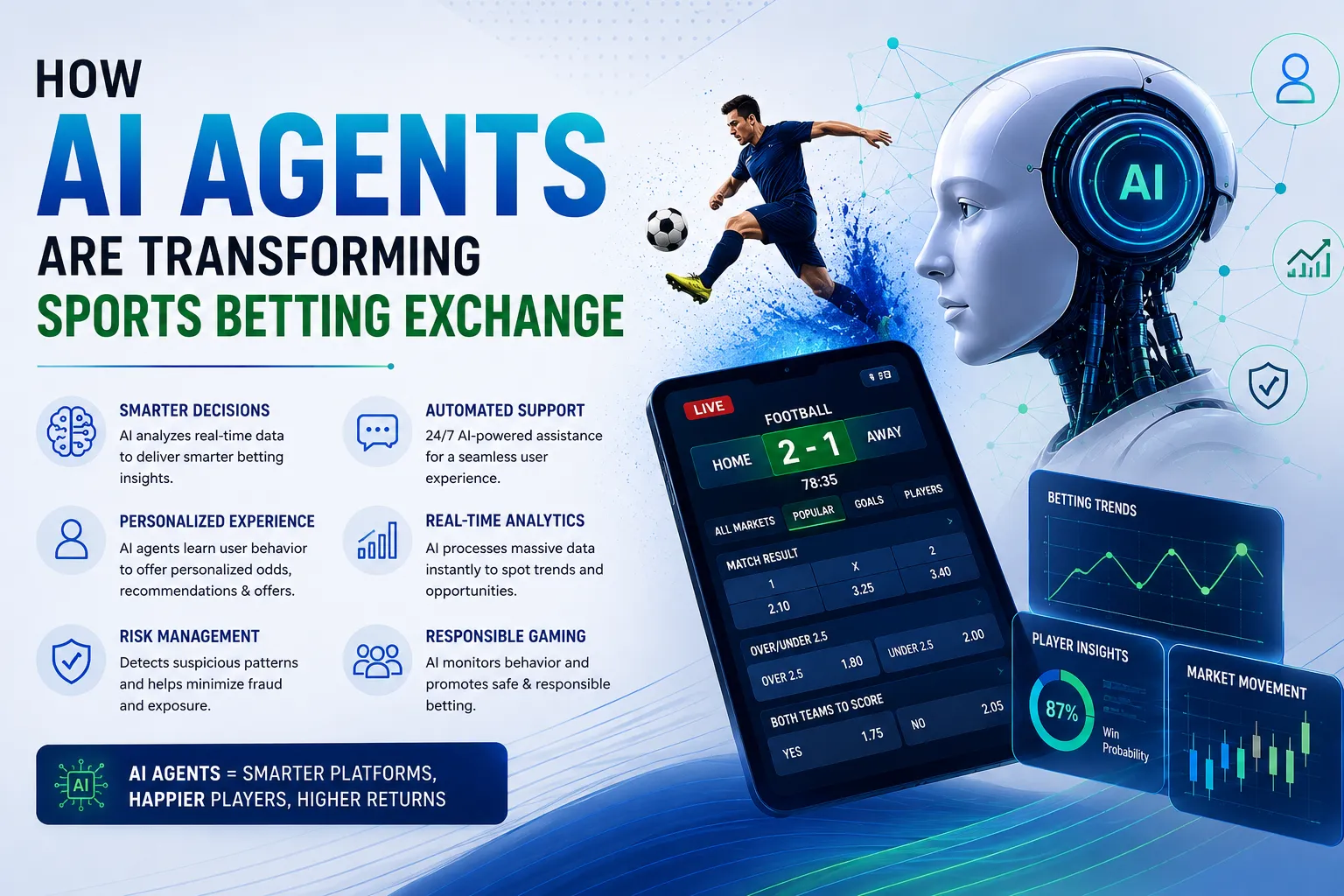
The sports betting exchange market is going to have explosive growth, with a projected revenue of around USD 230.5 billion driven by the digital revolution and integration of AI technologies. This explosive growth is not the result of market enthusiasm, but it reflects a fundamental shift in how platforms engage players and optimize operations with minimum risk.
At the core of this transformation are AI agents working for trusted AI sports betting development companies, which have intelligent systems capable enough to learn from behaviour, automate complex decisions and boost customer experience. Most of the top rates and trusted sports betting exchanges are already integrating these AI tools to create smoother, intelligent interfaces between players and systems. This is setting new benchmark for interaction and operational excellence.
We are here to explore the AI AGENT ARCHITECTURE in iGaming broadly, with a focus on sports betting exchanges specific to AI sports betting website development company worldwide.
HOW AI AGENTS WORK & WHAT ARE THE STAGES OF OPERATIONS?
AI agents operate through a structured four-stage process that distinguishes them from traditional software or basic chatbots. These stages enable them to interact intelligently with dynamic environments like sports betting platforms.
- Perception- AI agents first perceive their environment by collecting data from multiple sources. When it comes to sports betting, it includes user behaviour, market conditions, player and transaction history, platform interaction, and a gamut of data.
- Reasoning – Once the data is gathered, these agents apply advanced algorithms, predictive models, and contextual analysis to make informed decisions based on real-time conditions.
- Action- Based on their reasoning, AI agents act independently to assist players, adjust odds, personalize interfaces, or flag anomalies without requiring constant human intervention.
- Learning- After acting, agents continuously assess the outcomes of their actions. Using reinforcement learning and data feedback loops, they refine their decision-making to improve future performance.
This four-stage cycle of perceiving, reasoning, acting, and learning allows AI agents on AI betting exchange software to evolve over the period of time. Unlike rule-based systems, they follow prewritten scripts and adapt to new data and user behaviour, where they can process market data up to 1000 times faster than human analysts.
TECHNICAL FOUNDATION OF AI AGENTS
The most effective AI agents in sports betting exchange software follow the key technologies:
- Natural Language Processing-Enables agents to understand and respond to player queries, comments, and voice inputs with contextual accuracy.
- Computer Vision-Processes visual data streams, such as live match feeds, to enhance in-play betting decisions and experiences.
- Reinforcement Learning- Continuously improves agent decision-making by learning from outcomes and adjusting strategies over time.
- Predictive Analysis- Anticipates player needs, betting patterns, and potential risks based on historical and real-time data.
- Knowledge Graphs- Maintain contextual memory across player interactions, ensuring coherent conversations and personalized recommendations.
These technologies work to create agents that assist players, support operations, and increase the overall betting experience.
WHAT IS THE ROLE OF AI AGENTS IN IGAMING?
AI Agents of sports betting exchange development companies elevate the user experience by creating highly personalized interactions. They analyse player behaviour with the feature of AI decision-making in betting to predict the relevant bet based on players' records and preferences and current market conditions. Beyond this, AI Agents can customize the UI/UX based on individual player preferences. A player who focuses on in-play betting might see more promising live statistics, while someone who prefers pre-game analysis would receive enhanced analytical tools.
LEVERAGING OPERATIONS WITH MULTILANGUAGE SUPPORT
One of the most important operational challenges in global iGaming is language support. AI agents address this by providing real-time translation services for both written content and live dealer interactions. This capability allows operators to scale across markets without the extensive costs of hiring multilingual staff for every language.
In live dealer settings, AI voice agents can translate dealer instructions and player questions seamlessly and create an inclusive environment for international players. This technology extends beyond simple translation to include cultural nuances and betting terminology specific to different regions.
OPTIMIZING BUSINESS OPERATIONS THROUGH ADVANCED DATA PROCESSING
AI agents of top sports betting development platform providers transform business operations by handling complex data tasks that would otherwise require significant human resources. These agents can analyse massive datasets to identify market trends and player preferences. Monetary regulatory requirements across multiple jurisdictions and optimize promotional offers based on player behaviour and ROI analytics. The operational efficiency gained through these capabilities allows iGaming companies to focus human resources on strategic initiatives rather than routine data processing tasks.
IMPROVING DATA INTEGRATION AND ACCURACY
The iGaming industry deals with vast amounts of data from multiple sources, including sports events, payment gateways, and other regulatory requirements. AI agents excel at integrating these different data streams while maintaining accuracy and consistency. They can identify potential errors before they affect players or operations. Let’s take an example: Suppose there is a discrepancy in reported results and the settled bets on best sports betting website development platforms; an AI agent can flag this issue for review before it creates a customer service problem. This proactive approach to data quality improves both operational efficiency and player trust.
AUTOMATING THIRD PARTY INTEGRATION
To support this ecosystem, the best sports betting API integration is the foundational requirement, enabling real-time data exchange, operational stability, and faster time-to-market for new services. AI Agents simplify this process:
- Automating API connectivity and data mapping
- Monitoring integration in real time
- Troubleshooting connection issues
- Adapting to API changes from third-party providers.
- AI Risk Engine
- AI compliance Betting
This approach reduces development overhead and ensures more reliable connections between systems. When a payment provider updates their API, agents can identify the changes, adjust the integration accordingly, and minimize the disruption for a betting user experience.
PROMOTING RESPONSIBLE GAMING THROUGH PATTERN RECOGNITION
AI agents of trusted sports betting development companies can identify gaming patterns to identify potential sports betting behaviours before they get into some serious trouble. When concerning patterns emerge, the agents can take effective steps to promote healthier betting like:
- Providing reminders about time and money
- Setting and adjusting betting limits
- Offering resources for sports betting awareness
- Alerting human staff when intervention is needed.
WEBODOCTOR SPORTS BETTING SOFTWARE HELPS YOU ENABLE THE AI AGENT SYSTEM
webOdoctor, the best sports betting development company, functions as a custom Sports API integration provider, connecting operators directly with live data feeds. They build scalable exchange frameworks with admin control panels to operate within. To avoid market latency and losing target spreads, an AI engine must place trades in milliseconds that support automated order routing, secure database updates, and immediate wallet interactions so the agents can automatically scale and secure fractional profits.
Frequently Asked Questions
1. What are AI agents in sports betting exchange software?
AI agents in sports betting exchange software are intelligent systems that can collect and analyze data, make contextual decisions, perform automated actions, and learn from outcomes. They can support functions such as player personalization, risk detection, market analysis, customer support, API monitoring, and responsible gaming.
2. How do AI agents work in sports betting exchanges?
AI agents typically operate through four stages: perception, reasoning, action, and learning. They collect real-time data, analyze market and user information, take appropriate actions, and use feedback from previous outcomes to improve future decisions.
3. What technologies are used to build AI agents for sports betting?
Common technologies include Natural Language Processing (NLP), computer vision, reinforcement learning, predictive analytics, machine learning, knowledge graphs, real-time data processing, and AI-powered risk engines.
4. How can AI agents improve sports betting user experience?
AI agents can personalize betting interfaces, provide contextual recommendations, answer player queries, analyze preferences, deliver real-time information, and automate customer support. This enables betting platforms to provide more relevant experiences based on individual user behavior and preferences.
5. What is the role of AI in sports betting exchange development?
AI can support multiple areas of sports betting exchange development, including market analysis, risk management, player personalization, fraud detection, customer support, API monitoring, responsible gaming, and operational automation.
6. Can AI agents personalize sports betting platforms?
Yes. AI agents can analyze user interactions, betting preferences, historical activity, and real-time behavior to personalize dashboards, content, statistics, notifications, and other platform experiences.
7. How does AI help with sports betting API integration?
AI agents can assist with API connectivity, data mapping, integration monitoring, error detection, and identifying changes in third-party APIs. This can help operators maintain more reliable connections with sports data providers, payment gateways, and other external services.
8. How can AI agents improve sports betting risk management?
AI-powered risk engines can analyze large volumes of betting, transaction, and market data to identify unusual patterns and potential risks. Depending on the platform's rules and regulatory requirements, suspicious activity can be flagged for further review or trigger predefined controls.
9. Can AI agents support responsible sports betting?
Yes. AI agents can analyze behavioral patterns associated with potentially harmful betting activity and support responsible-gaming mechanisms such as spending or time reminders, betting limits, educational resources, and alerts for human review.
10. How does AI improve data accuracy in sports betting software?
AI systems can compare and analyze data from multiple sources, identify inconsistencies, detect anomalies, and flag potential errors. For example, an AI system could identify discrepancies between event results and bet-settlement data for operational review.